

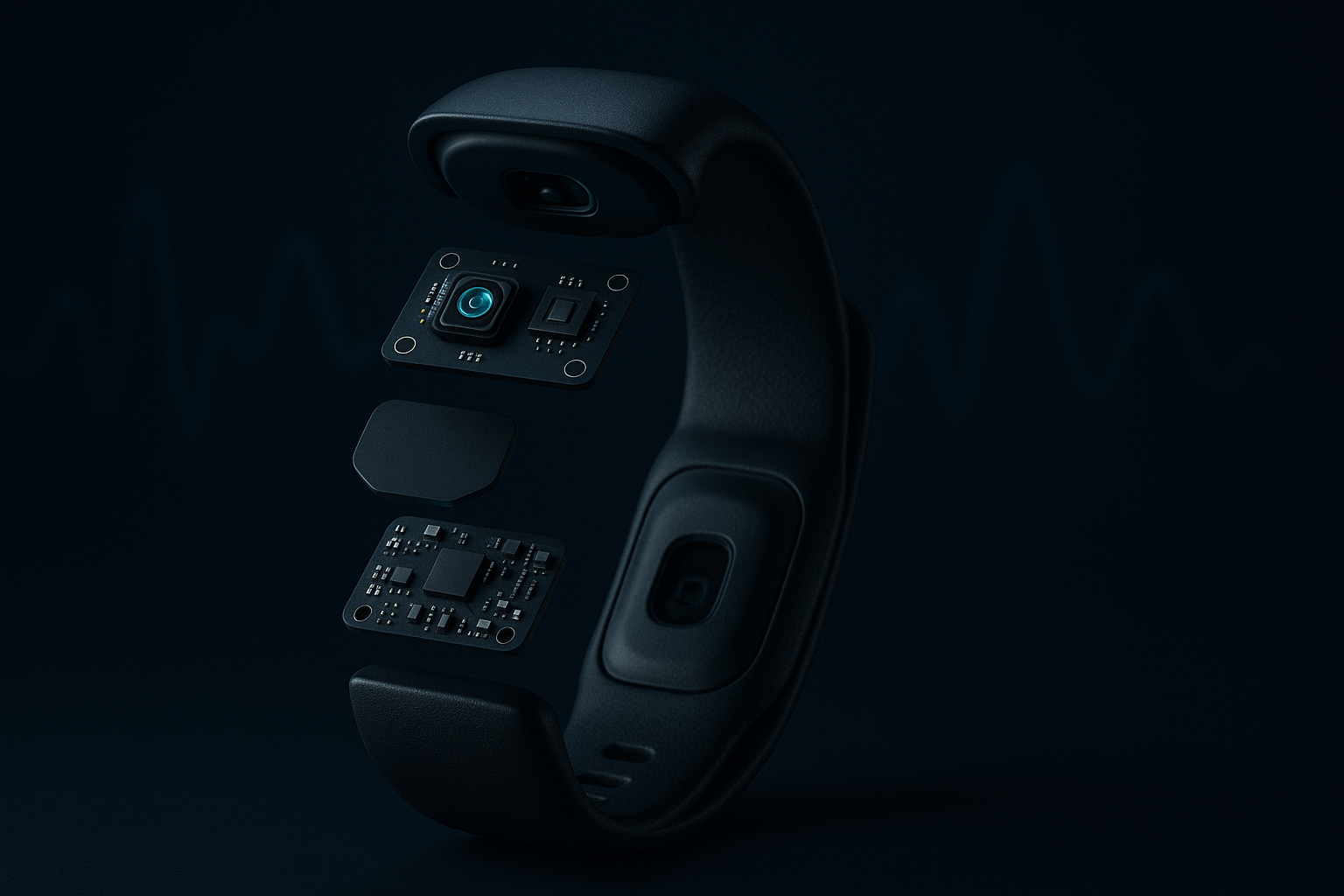
Wearable PPG systems look simple from the outside. In practice, performance depends on a tightly coupled stack of optics, electronics, industrial design, physiology, and signal-quality logic. A device can have a reasonable algorithm and still fail because the optical path is unstable. It can also have respectable raw hardware and still underperform because the fit, placement, or confidence logic is weak.
That is the central reality of wearable photoplethysmography: it is a system-design problem, not just a waveform-processing problem.
Core architecture of a wearable PPG system
A practical wearable PPG device usually includes:
- one or more LEDs
- one or more photodiodes
- an analog front end for amplification and conversion
- timing and LED-drive control
- optical shielding and a mechanical light path
- enclosure and strap or attachment mechanics
- firmware and signal-processing layers
- often an accelerometer or other motion reference
Each of these layers can determine whether the final output is believable in the field.
Optical stack design: LED, photodiode, spacing, and power
The emitter sends light into tissue. The photodiode converts returning light into current. That sounds simple, but the design space is full of tradeoffs.
| Design variable | Why it matters | Typical tradeoff |
|---|---|---|
| LED wavelength | Changes penetration depth and pulsatile contrast | Good for one site or metric may be poor for another |
| LED current and duty cycle | Affects signal amplitude, battery life, and thermal load | More light can help, but increases power cost and saturation risk |
| Photodiode area | Influences sensitivity and noise behavior | Larger area can collect more light but may add capacitance and front-end constraints |
| Emitter-detector spacing | Shapes sampling volume and depth sensitivity | Too small or too large can reduce usable contrast |
| Sampling timing | Controls ambient light rejection and dynamic behavior | Weak timing design can create avoidable artifacts |
More optical power is not a universal fix. Good wearable systems balance signal amplitude, power budget, thermal behavior, and analog front-end headroom.
Wavelength tradeoffs in wearables
Different wavelengths solve different problems.
- Green is common for wrist heart-rate tracking because it often yields strong superficial pulsatile contrast.
- Red can add value in multi-wavelength strategies and may behave differently with depth and site selection.
- Infrared is important in many oxygen-sensing approaches and broader optical system designs.
The right question is not “which wavelength is best?” The right question is “best for which body site, target output, motion environment, and power budget?”
Reflectance geometry is practical, but unforgiving
Most wearable PPG systems use reflectance geometry because the emitter and detector sit on the same side of tissue. That makes wrist-worn, arm-worn, or patch-like devices feasible.
The cost is sensitivity to mechanics. Small changes in:
- contact angle
- strap tension
- device rocking
- skin deformation
- local pressure distribution
can materially alter the signal. That is why wearable PPG cannot be evaluated as optics alone.
Placement matters more than many teams expect
Body site selection is often the difference between a product demo and a deployable device.
| Site | Benefits | Challenges |
|---|---|---|
| Finger | Often strong pulsatile signal, mature optical use case | Less practical for all-day wear |
| Wrist | Comfortable and familiar for consumer wearables | Motion, tendons, variable perfusion, pressure instability |
| Ear | Can provide stable pulse information in some applications | Comfort and user acceptance constraints |
| Forehead | Often useful in monitored settings | Less natural for consumer continuous wear |
| Upper arm or patch sites | May improve stability in some designs | Form-factor and adherence tradeoffs |
The best site in the lab is not always the best site for long-term adherence, and the most comfortable site is not always the most reliable optically.
Motion artifact is multiple problems at once
Motion artifact is often described too casually. In real wearable systems it can include:
- device translation relative to skin
- tissue deformation under the sensor
- pressure fluctuation from movement or strap shift
- muscle activity near the site
- posture-dependent perfusion changes
- acceleration-correlated optical contamination
This is why accelerometer fusion helps but rarely solves the whole problem. Motion artifact is partly mechanical, partly physiological, and partly optical.
Contact mechanics, perfusion, temperature, and skin effects
A wearable PPG system interacts with living tissue, not a stable test fixture.
Contact pressure
Too little pressure weakens coupling and allows ambient-light leakage. Too much pressure can compress microvasculature and distort the waveform.
Perfusion
Low perfusion reduces pulsatile amplitude, especially in cold conditions, vasoconstriction, or clinically compromised states.
Temperature
Thermoregulatory changes alter local blood flow and can change signal quality even if the device hardware is identical.
Skin and anatomy
Tissue thickness, local anatomy, pigmentation-related optical behavior, hair, and site-specific mechanics all affect performance.
These are not edge cases. They are everyday conditions for a deployed wearable.
Ambient light control and enclosure design
Ambient light rejection is often a hidden differentiator. Strong systems use:
- optical barriers and shielding
- synchronized LED sampling
- dark-frame subtraction or equivalent timing strategies
- enclosure designs that minimize leakage paths
This work is rarely visible in marketing material, but it often separates usable field data from noisy demos.
Signal quality logic matters as much as filtering
Filtering is necessary, but smoothing alone is not a quality strategy. If the upstream signal is poor, a polished output may simply hide failure.
Credible wearable PPG systems usually include:
- robust analog front-end design
- digital filtering matched to the use case
- motion-informed artifact suppression
- beat-level or window-level confidence scoring
- signal quality indices that can gate downstream outputs
- abstention logic when the signal is not trustworthy
A system that sometimes says “signal unavailable” can be more credible than one that always produces a number.
Validation reality: what publishable claims should look like
Many wearable PPG products are evaluated on best-case waveform screenshots or controlled treadmill clips. That is not enough for credible deployment claims.
Meaningful validation should describe:
- body site and wear configuration
- subject activity conditions
- motion and perfusion stress cases
- reference modality used for comparison
- failure-rate or abstention behavior, not just average accuracy
- population and environmental limits
For Sensor Bio, that is the right posture as well. The strongest positioning is restrained: design the optical system carefully, validate it under realistic conditions, and avoid claims that imply the device can infer more than the signal truly supports.
Bottom line
Wearable PPG performance is determined by the interaction of optical design, body site, mechanics, motion handling, and confidence-aware algorithms. Good systems are rarely magical. They are disciplined. If a team wants publishable credibility, it should spend as much time on placement, shielding, and validation logic as it does on the model layer.
FAQ
What components are essential in a wearable PPG system?
LEDs, photodiodes, an analog front end, LED-drive and sampling control, optical shielding, signal processing, and usually motion sensing for artifact context.
Why is wrist PPG so difficult?
Because the wrist is convenient but mechanically unstable, with tendon movement, frequent motion, changing pressure, and variable perfusion.
Is green always the best wavelength?
No. Green often works well for wrist-based heart-rate tracking, but optimal wavelength depends on site, target metric, optical geometry, and power constraints.
Can software fix a bad optical design?
Only partly. Algorithms can suppress some artifact, but they cannot recover reliable physiological information that was never captured cleanly.
What makes a wearable PPG system trustworthy?
A balanced optical stack, strong enclosure and contact design, signal-quality awareness, conservative validation, and the ability to abstain when the waveform is not reliable.
References
- Tamura T, Maeda Y, Sekine M, Yoshida M. Wearable Photoplethysmographic Sensors, Past and Present. Electronics. 2014.
- Allen J. Photoplethysmography and its application in clinical physiological measurement. Physiological Measurement. 2007.
- Fine J, Branan KL, Rodriguez AJ, et al. Sources of inaccuracy in photoplethysmography for continuous cardiovascular monitoring. Biosensors. 2021.
- Sun Y, Thakor N. Photoplethysmography revisited, from contact to noncontact, from point to imaging. IEEE TBME. 2016.
- Castaneda D, Esparza A, Ghamari M, Soltanpur C, Nazeran H. A review on wearable photoplethysmography sensors and their potential future applications in health care. International Journal of Biosensors & Bioelectronics. 2018.