


Science · Publications
Research publications
40 papers, abstracts, protocols and case reports from research and clinical teams, grouped by year, with a link to each source and a one-line summary of what it found.
About this list
These studies used earlier Biostrap and Wavelet Health hardware, the lineage the Sensor Bio platform grew from. Each summary describes what that study measured or found. It is not a claim about Sensor Bio V2, which is a general wellness device and is not FDA cleared.
Our history
From Wavelet Health to Biostrap to Sensor Bio
These studies used wristbands from each step of the line the Sensor Bio platform grew from.
Wavelet Health
Acquired by Biostrap
Wrist PPG wristbands and signal processing used by academic and clinical research teams.
Biostrap
Founded 2016
Acquired Wavelet Health and carried its wrist PPG technology into raw-waveform wearables for research and wellness programs.
Sensor Bio
2026
Biostrap became Sensor Bio in 2026. Sensor Bio V2 and an open platform for raw biometric data.
Showing 40 of 40.
2025
Peer-reviewed study · Sensors
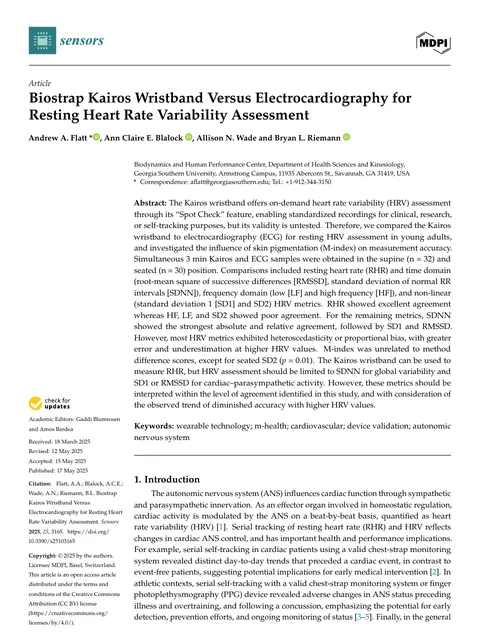
Biostrap Kairos Wristband Versus Electrocardiography for Resting Heart Rate Variability Assessment
Compared 3-minute Kairos Spot Check readings with simultaneous ECG in young adults; resting heart rate matched closely and SDNN and SD1 agreed best among HRV metrics.
2024
Peer-reviewed study · Applied Sciences
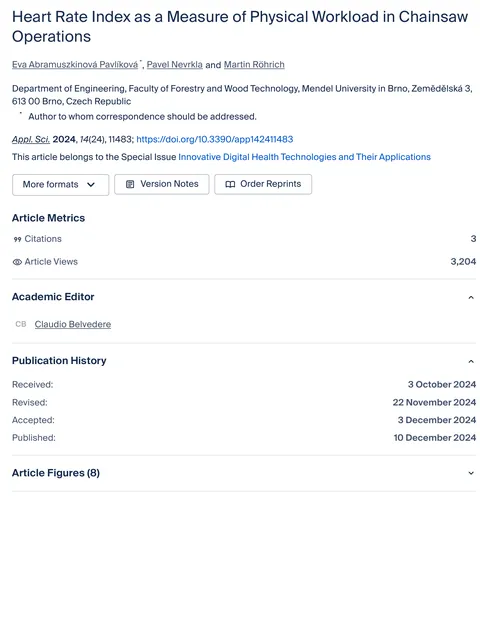
Heart Rate Index as a Measure of Physical Workload in Chainsaw Operations
Used heart rate from consumer wearables, including Biostrap, to build a simple workload index for chainsaw operators.
Protocol · JMIR Research Protocols
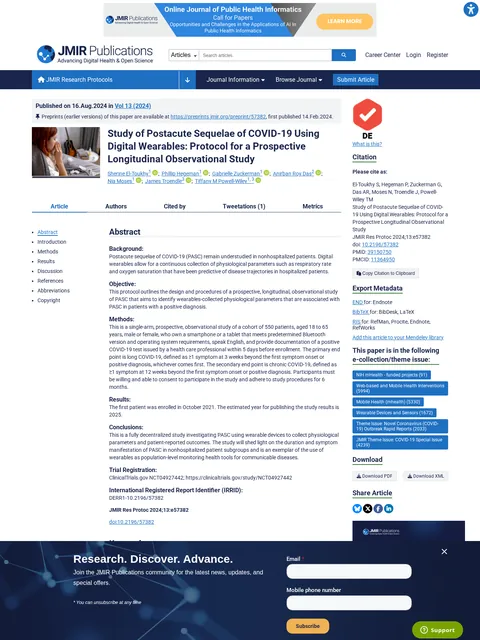
Study of Postacute Sequelae of COVID-19 Using Digital Wearables: Protocol for a Prospective Longitudinal Observational Study
Protocol for a 550-person observational study looking for wearable-collected signals associated with post-acute sequelae of COVID-19.
2023
Case study · International Journal of Sports Physiology and Performance
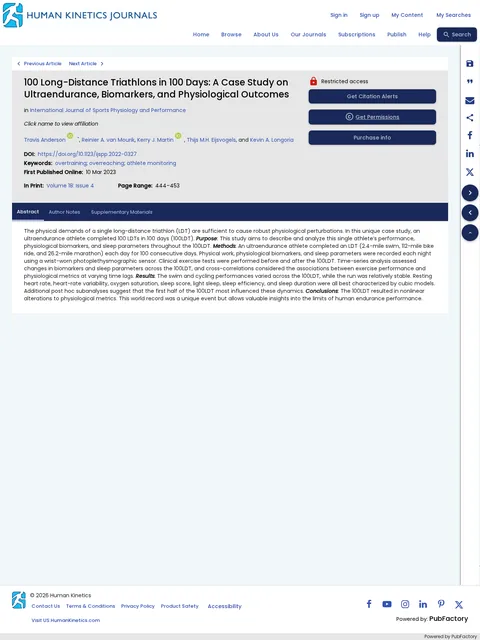
100 Long-Distance Triathlons in 100 Days: A Case Study on Ultraendurance, Biomarkers, and Physiological Outcomes
Tracked an athlete's overnight heart rate, HRV, SpO2 and sleep across 100 long-distance triathlons on 100 consecutive days.
Protocol · Research Square
A prospective natural history study of post acute sequalae of COVID-19 using digital wearables: Study protocol
Preprint protocol for a natural history study of post-acute sequelae of COVID-19 using wearable data.
Peer-reviewed study · Journal of Medical Internet Research
Accuracy of a Standalone Atrial Fibrillation Detection Algorithm Added to a Popular Wristband and Smartwatch: Prospective Diagnostic Accuracy Study
Tested the FibriCheck algorithm on a Biostrap wristband and a Fitbit Ionic in patients before and after cardioversion, against a 12-lead ECG.
Independent assessment · Marco Altini (Substack)
Biostrap Kairos
An informal side-by-side test comparing Biostrap Kairos beat intervals with a Polar H10 chest strap over standard Bluetooth. Biostrap supplied the sensor.
Peer-reviewed study · Journal of Medical Internet Research
Compliance Challenges in a Longitudinal COVID-19 Cohort Using Wearables for Continuous Monitoring: Observational Study
Tracked how often 122 people after COVID-19 sent wristband data; average compliance was 44.6% and older participants stayed longer.
2022
Preprint · JMIR Preprints
Long Coronavirus Infection is Associated with Significant Sleep Disturbances as Detected by Wearable Health Devices
Preprint version of the long COVID sleep study, comparing wearable sleep data after COVID-19 with matched controls.
Preprint · medRxiv
Prediction of deterioration from COVID-19 in patients in skilled nursing facilities using wearable and contact-free devices: a feasibility study
Tested whether wearable and contact-free sensors were feasible in skilled nursing facilities and whether they gave early signs of COVID-19 deterioration.
Peer-reviewed study · Journal of Medical Internet Research
Studying the Effect of Long COVID-19 Infection on Sleep Quality Using Wearable Health Devices: Observational Study
Compared wristband-derived sleep in 122 people after COVID-19 with 588 controls and found less light and deep sleep in the COVID-19 group.
Thesis · Salem State University
The Impact of Exercise and Heat Therapy on Overnight Heart Rate Variability
In six adults, heat therapy alone lowered overnight heart rate, while none of the exercise or heat sessions changed overnight HRV.
Thesis · Salem State University
Utilize Exercise and Heat Therapy to Improve Blood Pressure
Compared exercise, heat therapy and both combined on overnight ambulatory blood pressure trends in a small group of adults.



2021
Case report · Zenodo
A 35-year-old CEO who detected COVID-19 with his wearable biosensor - a Case Report
Described one person's wearable data around a COVID-19 infection and an early warning score adjusted to personal baselines.
Case report · mHealth
Two cases of COVID-19 monitored by a wearable biosensor: a case report
Followed the wearable data of two people through a COVID-19 infection.
2020
Peer-reviewed study · Computer Methods and Programs in Biomedicine
Assessment of a standalone photoplethysmography (PPG) algorithm for detection of atrial fibrillation on wristband-derived data
Ran the FibriCheck atrial fibrillation algorithm on 60-second wristband PPG in 60 older adults alongside a one-lead ECG reference.
Systematic review · Journal of Medical Internet Research
Current Evidence for Continuous Vital Signs Monitoring by Wearable Wireless Devices in Hospitalized Adults: Systematic Review
Reviewed 27 studies of 13 wearable wireless devices for continuous vital signs monitoring of adults in hospital wards.
Peer-reviewed study · International Journal of Exercise Science
Lower Limb Graduated Compression Garments Modulate Autonomic Nervous System and Improve Post-Training Recovery Measured via Heart Rate Variability
Measured HRV in novice runners to see how lower limb compression garments affected post-training recovery.
Protocol · BMJ Open
Protocol for a prospective, controlled, cross-sectional, diagnostic accuracy study to evaluate the specificity and sensitivity of ambulatory monitoring systems in the prompt detection of hypoxia and during movement
Protocol to test ambulatory monitors, including wrist-worn devices, against reference measures during movement and controlled low oxygen.

2019
Review · EAI PervasiveHealth 2019
An Overview of the Feasibility of Permanent, Real-Time, Unobtrusive Stress Measurement with Current Wearables
Surveyed how feasible continuous, real-time stress measurement is with the wearables available at the time.
Peer-reviewed study · npj Digital Medicine
Machine learning detection of obstructive hypertrophic cardiomyopathy using a wearable biosensor
A machine learning classifier on 42 wrist pulse wave features separated 19 people with obstructive hypertrophic cardiomyopathy from 64 healthy volunteers in a proof-of-principle study.
Correspondence · npj Digital Medicine
Reply to ‘Machine learning detection of obstructive hypertrophic cardiomyopathy using a wearable biosensor’
Authors' reply explaining the nested cross-validation behind the hypertrophic cardiomyopathy classifier and correcting the control count.
Conference paper · ACM IUI 2019
Towards a generalizable method for detecting fluid intake with wrist-mounted sensors and adaptive segmentation
Used wristband accelerometers and adaptive segmentation to detect drinking gestures in 30 people with 90.3% precision and 91.0% recall.
Peer-reviewed study · Digital Biomarkers
Usability of a Wrist-Worn Smartwatch in a Direct-to-Participant Randomized Pragmatic Clinical Trial
In a home screening trial, 43% of 230 older adults never sent data, those who started kept wearing the band, and 5.6% of recorded signal was usable for rhythm analysis.
Pilot study · Pituitary
Use of a wrist-mounted device for continuous outpatient physiologic monitoring after transsphenoidal surgery: a pilot study
Eleven patients wore a wrist wearable before and after pituitary surgery; activity fell by about half after the operation and data completeness was high for most signals.


2018
Conference abstract · Thorax (BTS Winter Meeting)
Cardiorespiratory physiology remotely monitored via wearable wristband photoplethysmography: feasibility and initial benchmarking
Reported feasibility and first benchmarks for remote cardiorespiratory monitoring with wristband PPG.
Peer-reviewed study · JMIR mHealth and uHealth
Design Rationale and Performance Evaluation of the Wavelet Health Wristband: Benchtop Validation of a Wrist-Worn Physiological Signal Recorder
Compared wristband heart rate, HRV and respiration rate with ECG and spirometry references in 35 adults, and tested signal quality against a finger clip.
Conference paper · IEEE BSN 2018
Estimation of HRV and SpO2 from wrist-worn commercial sensors for clinical settings
Used the wristband's red and infrared PPG to estimate heart rate, HRV and SpO2, and introduced a filter to clean up the red channel.
Conference paper · International Conference on Information Management and Technology (ICIMTech)
Health Assistant Wearable-Based Data Science System Model: A Pilot Study
Piloted a data science system model built on wearable data for a personal health assistant.
Conference abstract · Thorax (BTS Winter Meeting)
Preliminary results of ‘at risk’ asthma and COPD reviews by specialist teams in primary care
Reported early results from specialist team reviews of people with asthma and COPD at higher risk in primary care.
Peer-reviewed study · Sensors
Validation of Instantaneous Respiratory Rate Using Reflectance PPG from Different Body Positions
Developed and validated a method to estimate instantaneous respiratory rate from reflectance PPG across different body positions.
2017
Preprint · bioRxiv
Assessing actimeters for inclusion in the Healthy Brain Network
Compared the specifications and hands-on use of five research actimeters, including the Wavelet wristband, for a pediatric biobank.
Conference abstract · EP Europace
Assessment of pulse wave pressure changes for detection of arrhythmia and comorbidities using a wrist-worn wearable device
Studied pulse wave changes recorded at the wrist in people with clinically confirmed arrhythmia, and how consistently they wore the device.
Conference abstract · Circulation (AHA Scientific Sessions)
Machine Learning Detection of Obstructive Hypertrophic Cardiomyopathy Using a Wearable Biosensor
Early abstract comparing wrist pulse wave morphology in people with obstructive hypertrophic cardiomyopathy and unaffected controls using machine learning.
Conference abstract · Circulation (AHA Scientific Sessions)
Preliminary Evaluation of a Wrist Wearable Heart Rate Sensor for the Detection of Undiagnosed Atrial Fibrillation in a Real-World Setting
Reported early real-world results from self-enrolled participants who wore a wrist heart rate sensor, focused on atrial fibrillation that had not been diagnosed.
Trial design · EP Europace
Trial design of the WATCH AF trial - SmartWATCHes for detection of atrial fibrillation
Described the design of the WATCH AF trial, which set out to test smartwatch-based atrial fibrillation detection.
Conference abstract · Circulation (AHA Scientific Sessions)
Utility of a Wristband Device as a Portable Screening Tool for Obstructive Sleep Apnea
Compared overnight heart rate, HRV, SpO2 and respiration rate from a wrist PPG device with polysomnography in 30 people referred for a sleep study.



2016
Conference abstract · Heart Rhythm (HRS Scientific Sessions)
Changes in Physiologic Signals During Sleep Due to Arrhythmia
Looked at how wrist PPG signals recorded during sleep changed in people with arrhythmia.
Trial design · American Heart Journal
Rationale and design of a home-based trial using wearable sensors to detect asymptomatic atrial fibrillation in a targeted population: The mHealth Screening To Prevent Strokes (mSToPS) trial
Described the design of mSToPS, a home-based trial using wearable sensors to look for atrial fibrillation without symptoms.


2015
Conference paper · E-Health and Bioengineering Conference (EHB)
Bluetooth devices for the optimization of patients' workflow in a radiation oncology department
Tested Bluetooth activity trackers as a way to follow patient activity and quality of life inside a radiation oncology department workflow.

Research on Sensor Bio
Plan your next study with raw signal access
Raw PPG, configurable sensors, an SDK and an API for research and product teams.
Studies listed here were run by research and clinical teams on earlier Biostrap and Wavelet Health devices. Summaries are ours and describe each study, not Sensor Bio V2. Sensor Bio V2 is a general wellness device. It is not FDA cleared and is not intended to diagnose, treat, cure or prevent any disease.