
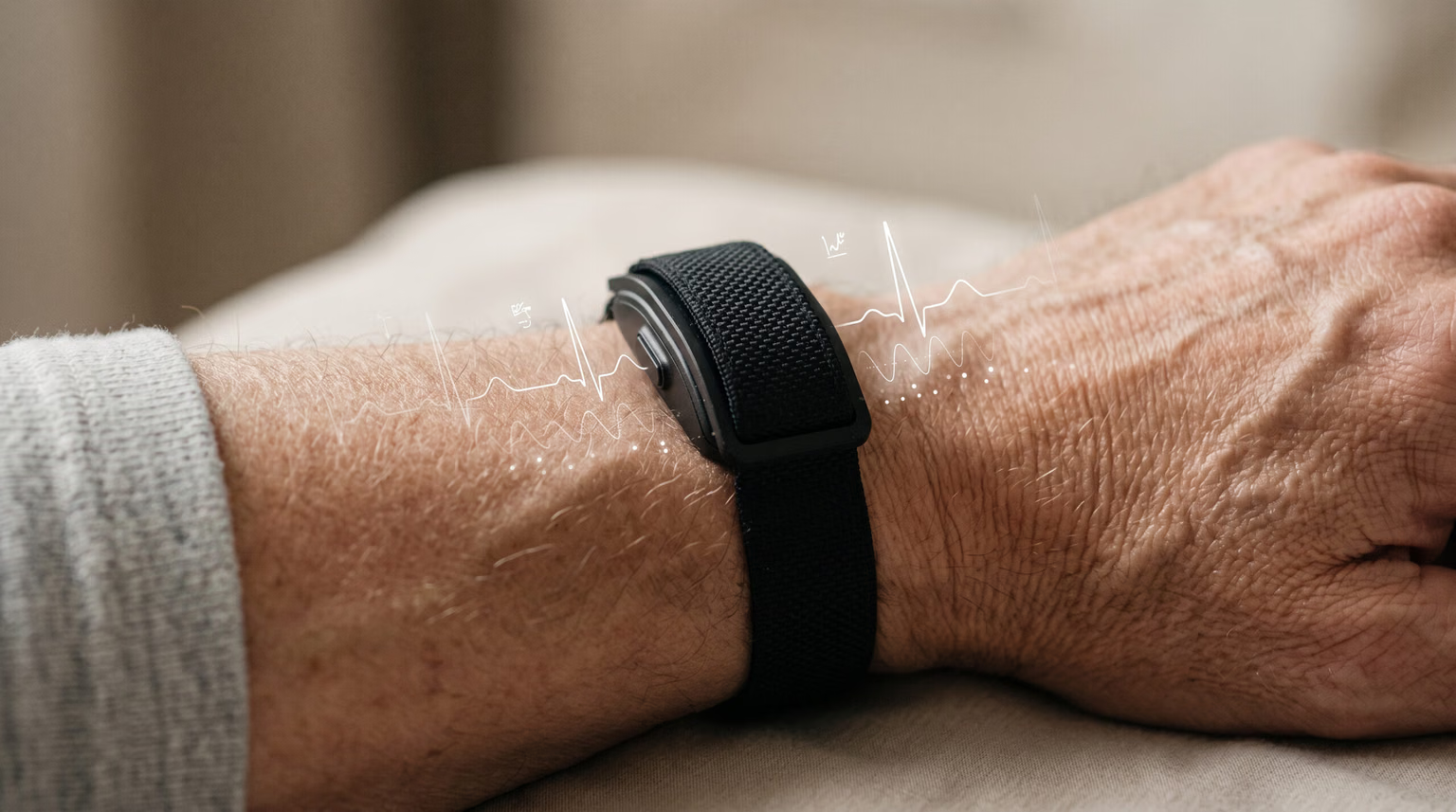
Biometrics & Data
Single-lead ECG selection for cardiovascular studies: validation and data-access criteria
By Sameer Sontakey
Evaluate single-lead ECG devices by validation quality, sampling rate, ambulatory signal fidelity, wear duration, and access to raw waveform data.
Quick answer: single-lead ecg is useful for ambulatory rhythm monitoring when the protocol defines placement, artifact handling, review workflow, and confirmation rules.
Single-lead ECG selection criteria
Single-lead ECG devices should be assessed for waveform access, sampling rate, readable wear time, annotation export, and clinician review support. Single-lead ECG can answer many rhythm questions, but studies should state which findings require confirmation and how unreadable windows are handled.
Choosing a single-lead ECG for cardiovascular research comes down to three make-or-break criteria: validated arrhythmia detection accuracy, a sampling rate high enough for trustworthy heart rate variability (HRV) extraction, and exportable raw waveform access that lets your team run its own offline analysis.1 Miss any one of them and the data may not survive peer review or meet the bar for a regulatory submission. The gap between a research-grade recording and a consumer-grade novelty recording is built into these technical specifications, not into marketing claims.
Quick answer: ambulatory ecg monitoring uses wearable or portable ECG recordings collected outside the clinic to detect rhythm patterns over hours, days, or weeks. Single-lead devices can be practical for studies, but selection should depend on arrhythmia endpoint, analyzable signal time, annotation workflow, and access to raw ECG strips.
ambulatory ecg monitoring
Use this section as a practical validation check before interpreting the signal in a clinical, research, or operational workflow.
Verification checklist
- Match monitoring duration to the expected frequency of symptoms or arrhythmias.
- Verify access to raw ECG waveform, annotations, and quality metrics.
- Predefine artifact handling, reviewer workflow, and adjudication criteria.
Related Sensor Bio reading
- Atrial Fibrillation Wearable Screening
- Post Tavr Ambulatory Ecg Monitoring
- Ppg Vs Ecg Vs Pulse Oximetry
Authoritative sources
What follows is a practical guide to the validation thresholds, signal-quality requirements, data-export standards, and form-factor tradeoffs that principal investigators and digital health platform engineers should work through before committing to a single-lead ECG system for ambulatory cardiovascular monitoring. If you are designing a decentralized trial, building a remote therapeutic monitoring (RTM) protocol, or auditing device candidates for an IRB submission, these are the criteria your purchasing decision should rest on.
What single-lead ECG captures and where it fits in cardiovascular studies
A single-lead ECG records one electrical vector of cardiac activity. In most wearable implementations that vector is a lead-I or lead-II equivalent, derived from two electrodes placed on the limbs, on the chest, or across a wearable form factor.2 That single projection captures atrial and ventricular depolarization sequences with enough fidelity for rhythm classification, heart-rate trending, and beat-to-beat interval measurement. What it cannot do is provide the spatial resolution required for ischemia localization, electrical axis deviation calculation, or detailed mapping of complex conduction abnormalities.
In practice, single-lead systems fill a gap between multi-lead Holter monitors and non-electrical modalities such as photoplethysmography (PPG). They deliver continuous electrical recording without the wiring burden of a 12-lead array, which matters when you need participants to tolerate weeks of wear. That makes them a natural fit for long-term ambulatory protocols, for RTM programs where therapy adherence and physiological response must be tracked simultaneously, and for decentralized clinical trials where participant adherence depends on unobtrusive wear.3
The tradeoff is straightforward: you lose spatial diagnostic information in exchange for longitudinal compliance. For many cardiovascular research questions, rhythm detection, interval variability, and autonomic trends, that tradeoff is worth making. But you need to know exactly where the line is.
Validation benchmarks: accuracy, sensitivity, and gold-standard comparison
Before a single-lead ECG device enters any cardiovascular study protocol, it needs a published validation study that compares its output against a gold-standard reference. The most common benchmark is atrial fibrillation (AF) detection: sensitivity and specificity measured against 12-lead ECG or intracardiac electrogram adjudication. A 2024 systematic evaluation found that automated AF detection algorithms applied to single-lead recordings achieved sensitivity values ranging from 71% to 95% and specificity from 84% to 97%.4 That range is wide enough to matter. The spread depends on the underlying classifier architecture, the prevalence of the target arrhythmia in the validation cohort, and whether the analysis was conducted in-clinic or during free-living ambulatory conditions.
The harder question is whether the specific device you are considering has been tested in a population that resembles yours. AF detection performance reported in a young, healthy cohort does not necessarily transfer to an older population with higher baseline ectopy or conduction delay. Before you cite a vendor's sensitivity number, check the validation cohort's age distribution, comorbidity profile, and recording conditions. If those do not overlap with your study population, the published figure may not hold.
AF detection is not the only validation endpoint. Ventricular ectopy burden estimation has also been benchmarked against Holter monitoring. A 2024 adhesive-patch study found that single-lead premature ventricular contraction (PVC) counts correlated within 2% to 4% of Holter-derived totals over 3-day wear periods, provided the patch maintained stable skin-electrode impedance throughout the recording window.1 Interval measurement accuracy matters as well: PR, QRS, and QT intervals estimated from lead-I alone showed clinically acceptable agreement with the 12-lead reference in controlled validation settings, though deviation increases measurably in patients with marked electrical axis shift.5
When you are evaluating validation literature, focus on three things: the reference standard used (a single cardiologist's interpretation is weaker than consensus adjudication by two blinded readers), the sample size (below 100 subjects raises questions about generalizability), and whether the analysis was pre-registered or post hoc. Atrial fibrillation wearable screening protocols that incorporate single-lead ECG as a first-pass tool require this level of validation rigor before deployment.
Sampling rate, bandwidth, and signal quality requirements for research-grade data
Technical specifications determine whether a single-lead ECG stream can support the analyses your study protocol requires. The IEC 60601-2-47 standard for ambulatory ECG systems mandates a minimum bandwidth of 0.05 Hz to 40 Hz and specifies sampling rate, input impedance, and common-mode rejection requirements for recorders intended for continuous monitoring.6 These are not arbitrary thresholds; they are the engineering minimum for capturing the frequency components that carry diagnostic information in the cardiac waveform.
For HRV time-domain metrics such as SDNN and RMSSD, a sampling rate of 250 Hz is the practical floor. Anything lower introduces quantization error that can distort beat-to-beat interval estimates, particularly when you need precision across thousands of consecutive beats. Moving to 500 Hz or higher reduces that error further and improves precision in QT interval and morphology-dependent analyses.7 ADC resolution should be at least 12 bits to preserve small-amplitude waveform features that lower-bit-depth conversion would flatten out.
Beyond the numbers on a datasheet, there are signal-processing decisions that matter just as much. Baseline wander rejection, motion artifact filtering, and beat-detection algorithm transparency are not optional for research use. A device that suppresses artifacts opaquely, without documenting what it removed or why, prevents you from assessing signal quality independently. You cannot run a secondary analysis on data that was already cleaned by an unknown pipeline. Beat-detection algorithm transparency matters whether you are working with ECG or PPG waveforms; the same principle applies.
Data-access criteria: raw waveform, timestamp fidelity, and export formats
A research-grade single-lead ECG platform must deliver raw waveform data. Derived metrics alone, heart-rate summaries, arrhythmia burden counts without the underlying trace, are not sufficient for publication or regulatory use. Raw ECG samples enable independent beat detection, custom filtering pipelines, and the kind of secondary analysis that published algorithms depend on for reproducibility.8
The export format itself is a gate. Open standards such as EDF (European Data Format), WFDB (WaveForm DataBase), or structured CSV with metadata headers support interoperability across MATLAB, Python, and R toolchains. If a platform locks its output behind a proprietary binary format, your analysis team has to reverse-engineer the decoder before they can do anything useful. That is not a research workflow; it is an obstacle course.
Timestamps need to be microsecond-accurate, particularly when you are synchronizing ECG streams with accelerometer, gyroscope, or external event markers from a separate data source. Time alignment errors of even a few hundred milliseconds can scramble the relationship between a physiological event and its electrocardiographic correlate. API endpoints should support both batch download and continuous streaming, with documented authentication, rate limits, and clear data-ownership terms. Real-time physiological data streaming infrastructure that delivers timestamped, unfiltered waveforms is what separates research platforms from dashboard-only tools.
A practical warning: platforms that hide raw data behind proprietary cloud interfaces, or that export only summary statistics and aggregated trend lines, compromise both reproducibility and regulatory submission readiness. Before you sign a contract, ask for a sample export file and run it through your analysis pipeline. If the file does not open in standard software or the timestamps drift, walk away.
| Form factor | Signal quality | Wear duration | Best use case |
|---|---|---|---|
| Adhesive patch | Highest; stable impedance | 1–14 days | Short-term ambulatory validation |
| Chest strap | Moderate; reusable | Weeks to months | Exercise and long-term monitoring |
| Wrist electrode | Lower; motion noise | Continuous | Convenience-first protocols |
| Ring electrode | Under evaluation | Continuous | Adherence-critical trials |
Form-factor tradeoffs: patch, chest strap, wrist, and ring electrodes
Electrode placement and form factor directly drive signal quality, participant adherence, and what your protocol can realistically ask of subjects over weeks or months. Adhesive patches provide the most stable skin-electrode interface available in a single-lead format because the electrode moves with the skin rather than sliding across it, minimizing motion artifact at the source.9 The limiting factor is wear duration: adhesive degradation, skin irritation, and hygiene concerns typically cap patch use at 1 to 14 days. That is enough for a short-term validation study. It is not enough for a longitudinal trial that runs for six months.
Reusable chest straps offer moderate signal quality across longer durations and work well for exercise physiology protocols and multi-week ambulatory studies. The electrode-skin interface is less stable than a patch but more reliable than wrist or ring placements. Wrist and ring placements trade signal fidelity for convenience, and the trade is significant: smaller contact area, greater distance from the cardiac vector, and higher susceptibility to motion noise all reduce waveform amplitude and baseline stability. These form factors remain viable for rhythm screening and heart-rate trending, but they require algorithmic compensation for motion artifact when HRV precision is the endpoint.3
An important methodological point: the validation literature for a given device was almost certainly collected under controlled conditions. If a ring-electrode system reports AF detection sensitivity above 90% in a lab setting with subjects seated and still, that number may not hold when the same subject is walking, gesturing, or sleeping. Smart ring vs wrist wearable PPG comparisons highlight the same principle: form factor determines which signal-degrading conditions your protocol can tolerate before the data becomes unreliable. Before you commit to a single-lead ECG device, test it under the worst-case motion conditions your study will encounter.
Limitations and when multi-lead monitoring remains necessary
Single-lead ECG has hard anatomical constraints that no amount of signal processing can overcome. It cannot localize myocardial ischemia. It cannot determine electrical axis deviation. It cannot identify posterior or right-ventricular infarction patterns that manifest in precordial leads V7 through V9 or right-sided V4R.2 Those are not edge cases. They are the reasons 12-lead ECG remains the standard of care in clinical cardiology.
Complex arrhythmias pose a similar challenge. Wide-complex tachycardias and bifascicular blocks often require multi-lead context for safe interpretation. A single-lead tracing that shows a wide QRS can narrow the differential diagnosis, but it cannot reliably distinguish ventricular tachycardia from supraventricular tachycardia with aberrancy. That distinction matters clinically, and it matters for study endpoints.
If your research question involves structural heart disease assessment, ischemic burden quantification, or electrophysiology mapping, single-lead ECG should not be your sole diagnostic modality. Echocardiography, cardiac MRI, or 12-lead Holter monitoring remain necessary adjuncts. Single-lead ECG is best understood as a screening and longitudinal trending tool, not a replacement for full cardiac workup. Heart rate variability monitoring, where beat-to-beat interval precision matters more than spatial resolution, is a domain where single-lead ECG performs well. But the line between what single-lead can and cannot do is drawn by anatomy, not by algorithm quality.