

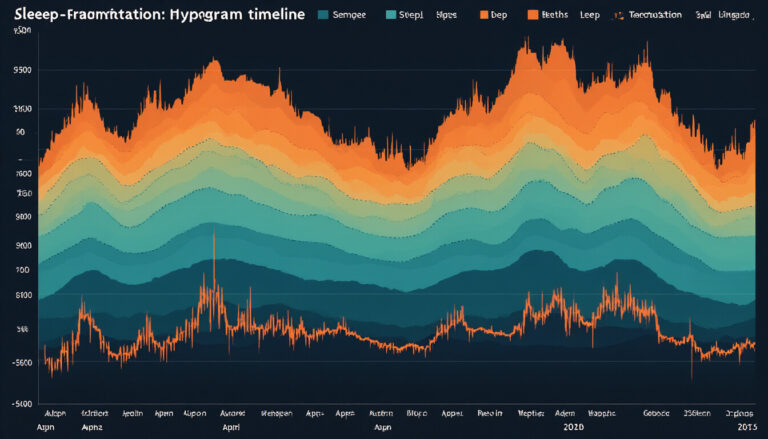
Accelerometer-derived sleep fragmentation uses movement patterns to estimate how often sleep is interrupted after sleep begins. Wake-after-sleep-onset, or WASO, is the cumulative time scored as wake between sleep onset and final awakening. It is not a direct measure of cortical arousal. It is a longitudinal rest-activity signal that can reveal disrupted sleep continuity when interpreted with method limits, population context, and reference sleep science 1, 2, 7, 40.
WASO matters because sleep is not only duration. Two people can spend eight hours in bed and show different physiological profiles if one has repeated post-onset wake periods. Fragmentation changes the continuity of autonomic, endocrine, immune, and metabolic regulation during the night 15, 16, 18. Accelerometry gives researchers a scalable way to track those continuity patterns outside the sleep laboratory.
This article explains what accelerometer-derived WASO measures, how it differs from polysomnography (PSG), and why fragmented sleep can be interpreted as a signal of physiological load rather than a standalone diagnosis.
What wake-after-sleep-onset measures
WASO is the total time scored as wake after sleep onset and before the final awakening. In PSG, wake is classified from electrophysiological signals. In actigraphy and accelerometer-based systems, wake is inferred from movement patterns within scored epochs 2, 3, 5.
That distinction is central. Accelerometers do not measure electroencephalographic sleep stage. They measure motion. Algorithms then classify epochs as likely sleep or likely wake based on activity counts, timing, and sometimes adjacent physiological signals. Higher WASO means more time classified as wake during the intended sleep period. It does not specify why the person was awake.
Sleep fragmentation is broader than WASO. It can include frequent transitions, awakenings, arousals, sleep-stage instability, or movement bursts. Accelerometer-derived fragmentation usually describes rest-activity disruption. PSG-derived fragmentation can describe cortical arousals and stage transitions. The terms overlap, but they are not interchangeable 7, 9.
For longitudinal monitoring, WASO is useful because it captures sleep maintenance. Sleep duration can remain stable while WASO rises. That pattern may indicate lower sleep efficiency, more interruptions, or a rest interval contaminated by wakefulness. It also may reflect artifact, incorrect bed interval detection, illness, pain, caregiving, environmental disruption, or sleep-disordered breathing. Context decides interpretation.
How accelerometers infer sleep and wake
Actigraphy has been used in sleep and circadian research for decades. Foundational work established that wrist activity can approximate sleep-wake patterns in natural environments, especially across repeated nights 2, 3, 4. Early algorithms classified sleep and wake from activity counts within short epochs. Later methods added adaptive thresholds, surrounding-window features, device-specific calibration, and machine learning 5, 11, 12.
The core method is simple. Low movement during a rest interval is more likely to be classified as sleep. Higher movement is more likely to be classified as wake. The practical strength is scalability. A wrist accelerometer can collect many nights of passive data in a home setting. That makes it useful for population studies, longitudinal studies, and research pipelines where PSG is not feasible at scale.
The weakness is specificity. Quiet wake can look like sleep. Restless sleep can look like wake. Marino et al. found that wrist actigraphy generally shows high sensitivity for detecting sleep, but lower specificity for detecting wake compared with PSG 7. A systematic review by Conley et al. reached a similar conclusion: agreement varies across populations, conditions, devices, and scoring rules 9.
This is why accelerometer-derived WASO should be treated as an estimated endpoint. It is stronger for repeated-night pattern analysis than for single-night clinical classification. It is also stronger when paired with a clearly defined rest interval, raw-data access, and transparent algorithm documentation.
That is why reproducibility requires more than a metric label. A study should report device placement, epoch length, algorithm version, rest-interval rule, minimum valid nights, non-wear logic, and whether diaries or event markers were used. These details allow a WASO endpoint to be audited. Without them, the same term can represent different measurement pipelines 8, 11, 12, 13.
Why fragmentation has physiological meaning
Sleep continuity supports autonomic downshifting during the night. During consolidated non-rapid eye movement sleep, heart rate and sympathetic activity generally decline, while parasympathetic influence becomes more prominent. Sleep disruption can interrupt that pattern 16, 17, 38.
Fragmentation does not need to be dramatic to matter. Repeated awakenings or arousal-like events can produce transient cardiovascular and autonomic responses. Lévy and Pépin described autonomic markers as clinically useful for understanding sleep fragmentation, while Janackova and Sforza reviewed cortical and autonomic features of fragmented sleep across sleep disorders 14, 15. These papers support a restrained interpretation: fragmentation can be a physiological stress signal, but the mechanism depends on the underlying cause.
HRV adds one measurement lens. Standard HRV methods define time-domain and frequency-domain measures that reflect autonomic modulation, with important constraints around recording duration, stationarity, and context 38, 39. More recent work shows that HRV during sleep can be reliable under controlled conditions, but disrupted sleep changes signal stability and interpretation 41.
Accelerometer-derived WASO does not measure autonomic activity directly. It identifies likely wake periods. The physiological inference becomes stronger when WASO is interpreted alongside heart rate, HRV, respiratory metrics, temperature, symptom logs, medication timing, and environmental context.
This distinction is especially important for sleep HRV. Slow-wave sleep can be an attractive window for autonomic analysis because respiration, posture, and behavior are more constrained than waking conditions, but the recording condition still has to be defined 47. Recent work linking slow-wave sleep HRV with central autonomic network connectivity reinforces the concept that sleep is a regulated neuroautonomic state, not a passive absence of wakefulness 48. Fragmentation can therefore matter even when total sleep time appears adequate. It changes the continuity of the physiological state being sampled.
Allostatic load and cardiometabolic context
Allostatic load describes cumulative physiological strain from repeated adaptation to stressors. Sleep loss and circadian disruption have long been discussed as drivers of metabolic, endocrine, immune, and autonomic stress biology 18, 19, 20. Fragmented sleep fits this framework because it can reduce the continuity of nightly recovery physiology.
The 2026 Sleep Health seed paper examined wrist-worn accelerometer-measured sleep fragmentation and obesity risk, with socioeconomic gradients and mediation by allostatic load 1. The important point is methodological. The study uses accelerometer-derived sleep continuity to connect a behavioral signal with population-level physiological burden. It does not make WASO a diagnostic test for obesity. It supports the idea that sleep fragmentation can sit inside a broader pathway involving social context, cumulative load, and cardiometabolic risk.
That framing aligns with older evidence. Experimental sleep debt affected metabolic and endocrine function in the Lancet study by Spiegel et al. 18. Reviews link sleep duration and obesity, while cardiometabolic reviews emphasize the multi-factor nature of obesity risk 26, 27, 29. Large population analyses also show that obesity prevalence and cardiometabolic burden vary across social and demographic groups 28, 30.
WASO should therefore be read as one signal within a network. A high or rising WASO pattern may coincide with endocrine stress, sympathetic activation, altered appetite regulation, reduced daytime function, or inflammatory activity. It cannot identify which pathway is active without additional data.
What accelerometry can and cannot replace
PSG remains the reference method for sleep architecture. It measures brain activity, eye movements, muscle tone, respiratory signals, oxygenation, and limb movements depending on montage. Accelerometry does not capture those channels. It cannot score cortical arousals, respiratory events, or sleep stages with the same evidentiary basis as PSG.
Actigraphy has a different role. It supports repeated, naturalistic measurement. The American Academy of Sleep Medicine guideline supports actigraphy for selected sleep and circadian rhythm evaluations, while recognizing its limits 8. The best use case is not replacing PSG. It is extending sleep continuity measurement across time.
Method choices matter. Rest interval detection, non-wear handling, epoch length, algorithm thresholds, device placement, comorbid conditions, and population age can change WASO estimates 10, 13, 44, 45. In older adults, pregnancy, chronic pulmonary disease, neurologic disease, and hospital settings, movement-sleep relationships may differ from healthy adult reference samples.
This is also why raw accelerometer access matters. Research-grade pipelines need the ability to audit signal quality, inspect rest intervals, compare scoring models, and reproduce endpoints. A WASO value without algorithmic context is a weak scientific object.
Evidence summary
| Evidence area | Study design or source type | Main relevance for WASO interpretation | Citation | |—|—|—|—| | Wrist accelerometry and obesity risk | Population study using wrist-worn accelerometry | Recent example linking fragmentation, obesity risk, socioeconomic gradients, and allostatic load | Xing et al., 2026 1 | | Actigraphy vs PSG | Validation and meta-analysis literature | Actigraphy is stronger for sleep detection than wake detection, so WASO requires caution | Marino et al., 2013; Conley et al., 2019 7, 9 | | Autonomic response to fragmentation | Mechanistic reviews | Fragmented sleep can interrupt autonomic regulation and cardiovascular downshifting | Janackova and Sforza, 2008; Tobaldini et al., 2017 15, 16 | | Allostatic load | Stress biology reviews | Sleep disruption can contribute to cumulative physiological strain | McEwen, 2006; McEwen and Karatsoreos, 2022 19, 20 | | Cardiometabolic context | Reviews and population studies | Sleep continuity signals should be interpreted within multi-factor obesity and metabolic risk pathways | Valenzuela et al., 2023; Almeida et al., 2025 26, 31 |
How to interpret WASO responsibly
A single WASO value has limited meaning. A repeated pattern is more useful. Researchers should evaluate WASO across multiple nights, compare weekdays and weekends, examine rest interval quality, and look for co-occurring changes in heart rate, HRV, activity timing, and temperature.
Trend direction matters more than isolated thresholds. Normative sleep values vary across the lifespan 24. Device algorithms also vary. A 45-minute WASO estimate from one pipeline may not be equivalent to a 45-minute estimate from another. Cross-study comparison requires transparent scoring.
The strongest interpretation is pattern-based. Stable low WASO across weeks suggests consolidated rest intervals. Rising WASO across repeated nights suggests increasing sleep continuity disruption. Highly variable WASO may indicate irregular schedules, environmental disturbance, inconsistent wear, or unstable physiology. None of these interpretations should be treated as a diagnosis.
For research and clinical operations, accelerometer-derived WASO is most defensible when paired with:
- raw accelerometer access and documented preprocessing,
- explicit sleep window or rest interval rules,
- non-wear and artifact handling,
- repeated-night aggregation,
- co-signals such as HRV and skin temperature,
- clear separation between screening, research, and diagnostic workflows.
[Internal link: accelerometer signal quality and motion artifact] [Internal link: what actigraphy can and cannot measure] [Internal link: HRV and autonomic nervous system fundamentals] [Internal link: sleep architecture and wearable sleep staging] [Internal link: Sensor Bio research infrastructure]
FAQ
What is wake-after-sleep-onset?
Wake-after-sleep-onset is the total time scored as wake after sleep begins and before final awakening. In accelerometer-derived sleep analysis, it is estimated from movement patterns during the rest interval. Higher WASO generally indicates less consolidated sleep, but it does not identify the cause of wakefulness. It should be interpreted with repeated-night context and method transparency 2, 7.
Can an accelerometer measure sleep fragmentation?
An accelerometer can estimate rest-activity fragmentation. It can detect movement patterns that algorithms classify as likely wake during the sleep period. It cannot directly measure cortical arousals or sleep stages. That makes accelerometer-derived fragmentation useful for longitudinal monitoring, but not equivalent to PSG-derived sleep architecture 8, 9.
Is WASO the same as sleep efficiency?
No. WASO is the amount of wake time after sleep onset. Sleep efficiency is usually the percentage of time in bed or rest interval scored as sleep. WASO contributes to sleep efficiency, but the two metrics are not identical. A person can have similar sleep efficiency with different distributions of awakenings, sleep onset latency, and final wake timing.
Why would sleep fragmentation relate to allostatic load?
Fragmented sleep can reduce the continuity of nightly autonomic, endocrine, and immune regulation. Allostatic load describes cumulative physiological strain from repeated adaptation to stressors. Sleep disruption is one plausible contributor to that strain, especially when it persists over time or occurs alongside social, metabolic, and circadian stressors 19, 20, 21.
Does high WASO diagnose a sleep disorder?
No. High WASO does not diagnose a sleep disorder by itself. It can indicate disrupted sleep continuity, but the cause may be behavioral, environmental, physiological, medication-related, or measurement-related. Clinical diagnosis requires appropriate clinical assessment and, when indicated, PSG or other validated testing.
Why not use PSG for every sleep fragmentation question?
PSG provides detailed physiology, but it is resource intensive and usually covers limited nights. Accelerometry can collect repeated data in natural settings. The methods answer different questions. PSG is stronger for architecture and arousals. Accelerometry is stronger for longitudinal rest-activity continuity at scale 7, 8, 46.
References
References
- Wrist-worn accelerometer measured sleep fragmentation and obesity risk: Socioeconomic gradients and mediation by allostatic load. 2026. 10.1016/j.sleh.2026.03.010
- The Role of Actigraphy in the Study of Sleep and Circadian Rhythms. 2003. 10.1093/sleep/26.3.342
- The role of actigraphy in sleep medicine. 2002. 10.1053/smrv.2001.0182
- Activity-Based Sleep-Wake Identification: An Empirical Test of Methodological Issues. 1994. 10.1093/sleep/17.3.201
- Automatic Sleep/Wake Identification From Wrist Activity. 1992. 10.1093/sleep/15.5.461
- Measuring Sleep: Accuracy, Sensitivity, and Specificity of Wrist Actigraphy Compared to Polysomnography. 2013. 10.5665/sleep.3142
- Use of Actigraphy for the Evaluation of Sleep Disorders and Circadian Rhythm Sleep-Wake Disorders: An American Academy of Sleep Medicine Clinical Practice Guideline. 2018. 10.5664/jcsm.7230
- Agreement between actigraphic and polysomnographic measures of sleep in adults with and without chronic conditions: A systematic review and meta-analysis. 2019. 10.1016/j.smrv.2019.05.001
- Actigraphy-based sleep estimation in adolescents and adults: a comparison with polysomnography using two scoring algorithms. 2018. 10.2147/nss.s151085
- Application of deep learning to improve sleep scoring of wrist actigraphy. 2020. 10.1016/j.sleep.2020.05.008
- Validation of an automated sleep detection algorithm using data from multiple accelerometer brands. 2023. 10.1111/jsr.13760
- Factors that May Influence the Classification of Sleep-Wake by Wrist Actigraphy: The MrOS Sleep Study. 2011. 10.5664/jcsm.1190
- Sleep fragmentation: clinical usefulness of autonomic markers. 2003. 10.1016/j.sleep.2003.07.003
- Neurobiology of Sleep Fragmentation: Cortical and Autonomic Markers of Sleep Disorders. 2008. 10.2174/138161208786549335
- Sleep, sleep deprivation, autonomic nervous system and cardiovascular diseases. 2017. 10.1016/j.neubiorev.2016.07.004
- Sympathetic neural responses to sleep disorders and insufficiencies. 2022. 10.1152/ajpheart.00590.2021
- Impact of sleep debt on metabolic and endocrine function. 1999. 10.1016/S0140-6736(99)01376-8
- Sleep deprivation as a neurobiologic and physiologic stressor: allostasis and allostatic load. 2006. 10.1016/j.metabol.2006.07.008
- Sleep Deprivation and Circadian Disruption Stress, Allostasis, and Allostatic Load. 2022. 10.1016/j.jsmc.2022.03.005
- Sleep and chronic stress: new directions for allostatic load research. 2015. 10.1016/j.sleep.2014.07.029
- Meta-Analysis of Quantitative Sleep Parameters From Childhood to Old Age in Healthy Individuals: Developing Normative Sleep Values Across the Human Lifespan. 2004. 10.1093/sleep/27.7.1255
- Obesity and the risk of cardiometabolic diseases. 2023. 10.1038/s41569-023-00847-5
- Sleep Duration and Obesity in Adults: What Are the Connections?. 2016. 10.1007/s13679-016-0225-8
- Has the prevalence of overweight, obesity and central obesity levelled off in the United States? Trends, patterns, disparities, and future projections for the obesity epidemic. 2020. 10.1093/ije/dyz273
- Obesity: A Global Public Health Challenge. 2018. 10.1373/clinchem.2017.273052
- Global Impact of Obesity. 2023. 10.1016/j.gtc.2023.03.002
- Associations between self-reported and actigraphy measured sleep duration with metabolic syndrome: evidence from NHANES 2011-2014. 2025. 10.1007/s10865-025-00593-8
- Heart Rate Variability. 1996. 10.1161/01.cir.93.5.1043
- A Quantitative Systematic Review of Normal Values for Short-Term Heart Rate Variability in Healthy Adults. 2010. 10.1111/j.1540-8159.2010.02841.x
- Short-term prognostic effects of circulating regulatory T-Cell suppressive function and vascular endothelial growth factor level in patients with non-small cell lung cancer and obstructive sleep apnea. 2020. 10.1016/j.sleep.2020.02.009
- Reliability of heart rate variability during stable and disrupted polysomnographic sleep. 2022. 10.1152/ajpheart.00143.2022
- Objective sleep in pregnant women: a comparison of actigraphy and polysomnography. 2018. 10.1016/j.sleh.2018.07.011
- Actigraphy scoring for sleep outcome measures in chronic obstructive pulmonary disease. 2017. 10.1016/j.sleep.2017.06.012
- A novel approach using actigraphy to quantify the level of disruption of sleep by in-home polysomnography: the MrOS Sleep Study. 2017. 10.1016/j.sleep.2016.11.019
- Is slow wave sleep an appropriate recording condition for heart rate variability analysis?. 2005. 10.1016/j.autneu.2005.06.002
- Heart rate variability during slow wave sleep is linked to functional connectivity in the central autonomic network. 2023. 10.1093/braincomms/fcad129