
PROTECT THE SIGNAL
Sensor Bio V2
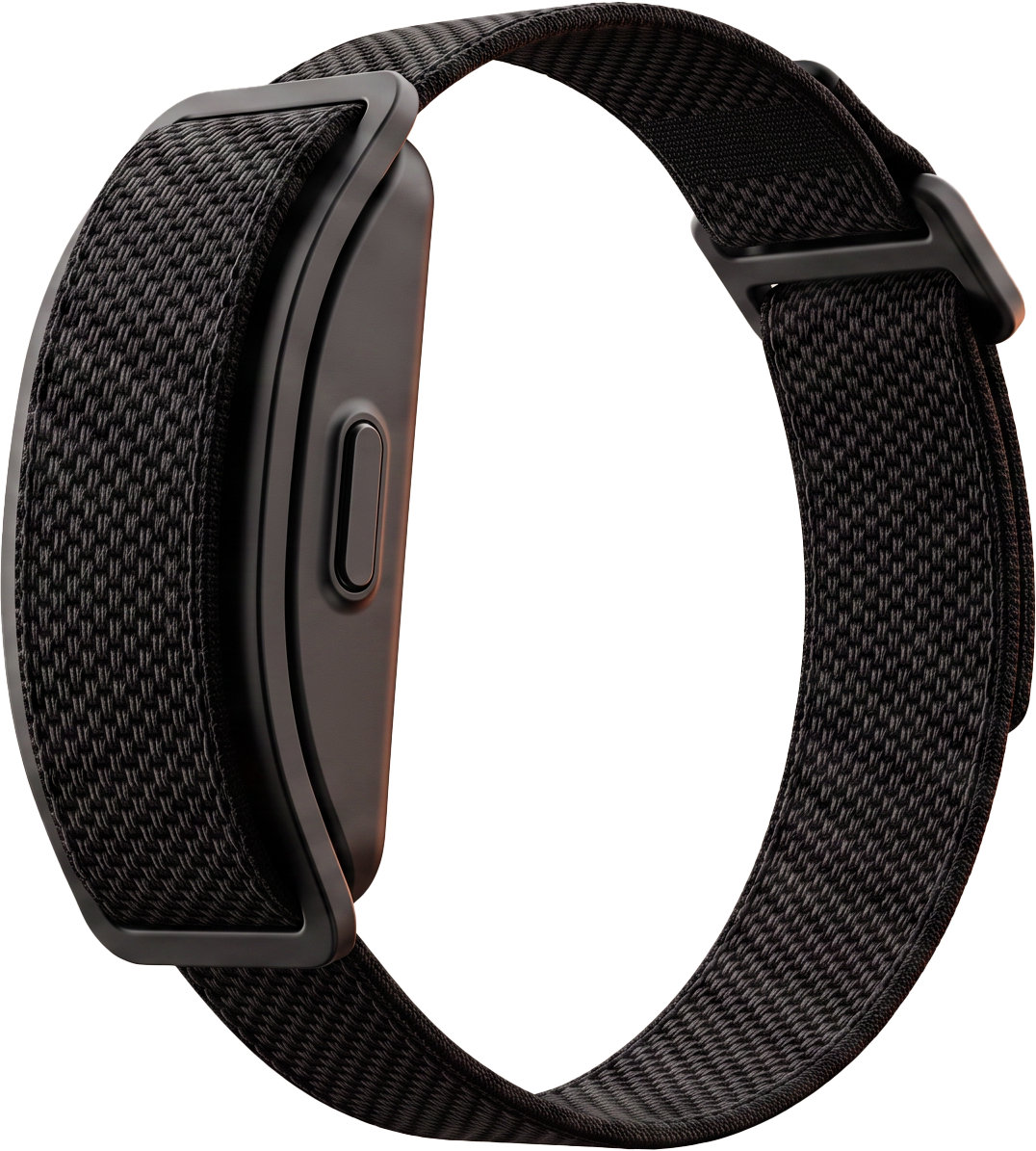
A screenless band that captures continuous physiological signal and hands the raw waveform to the system above it. No screen, no summarized number, just capture: three-wavelength PPG at green, red, and infrared, sampled up to 100 Hz. The raw signal itself, accurate enough to build on.
5-7 days
Continuous 24/7 wear
100 Hz
Raw waveform export
3 wavelengths
Green, red, infrared PPG
IP68
1.5 m for 30 minutes
1 oz
Sealed one-size band
BLE 5.0
Bluetooth 4.0 minimum
±0.1°C
Skin temperature accuracy
~14 days
On-device buffer
15 min
Emergency charge to 20%
2 GB
Per export file
8 SDK surfaces
From vitals to live stream
5-7 days
Continuous 24/7 wear
100 Hz
Raw waveform export
3 wavelengths
Green, red, infrared PPG
IP68
1.5 m for 30 minutes
1 oz
Sealed one-size band
BLE 5.0
Bluetooth 4.0 minimum
±0.1°C
Skin temperature accuracy
~14 days
On-device buffer
15 min
Emergency charge to 20%
2 GB
Per export file
8 SDK surfaces
From vitals to live stream
Where the Signal Starts
Built as infrastructure, not as a gadget.
Four properties decide whether a wearable can carry an institutional workload. V2 was designed against all four before it was designed to look like anything.
01 / Raw data
The full waveform, not the summary
Raw PPG, inter-beat intervals, and accelerometer export at up to 100 Hz. Scores sit on top of the exposed signal, with the context that shows what drove the number.
02 / Platform
One system, every use case
The band, the cloud, and the SDK are one product. Enterprise, defense, research, and more build on the platform directly rather than around it.
03 / White label
Your brand on the signal
Native white-label from the first deployment. The partner's brand carries the hardware, the app, and the reporting end to end.
04 / Configurable
Shaped to the deployment
Capture cadence, data model, retention, alerting, and reporting are configured to the environment: a hospital, a base, a research protocol.
A wellness tracker tells a person a score and stops there.
V2 shows the score, the raw signal behind it, and hands over the data to prove it.
truth over interpretation
Hardware specification
The band, line by line.
Model
Sensor Bio V2, model #S2001
Form factor
Screenless wrist band, low-profile curved sensor module
Sensor and strap ship as a sealed, non-separable unit. One size, no S/M/L.
No display by design. There is nothing on the band to read, because the signal is not the point of interaction.
Case and housing material
Plastic wristband form factor
Sensor window is optical-grade plastic covering the PPG sensor against the skin
Sensor hardware
Multi-wavelength raw PPG: green ~530 nm, red ~655 nm, infrared ~940 nm
Three-axis accelerometer, ±8G default range, ±16G maximum. No GPS.
Skin-temperature sensor via metal contact plate, accurate to ±0.1°C
Sampling
50 Hz by default, configurable to 25 or 100 Hz per organization
Up to 100 Hz raw export. Duty cycle is configurable alongside sampling rate.
Continuous wear and battery
5 to 7 days at default duty-cycled 24/7 wear
Emergency charge 0% to 20% in about 15 minutes. Full charge 0% to 100% in 120 to 240 minutes.
Faster drain comes from high-frequency research sampling modes or frequent active syncing
Water and dust resistance
IP68. Safe for rain, sweat, and hand-washing.
Submersion up to 1.5 m for up to 30 minutes.
Weight
Device, sensor and strap together: approximately 1 oz
Package weight: 4 oz
Operating temperature
−40°C to +85°C
Connectivity
Bluetooth Low Energy 5.0. Minimum phone requirement Bluetooth 4.0.
No traditional pairing, PIN, or bonding. Connection is initiated by double-clicking the device button in the app.
On-device storage
Approximately 14 days of data at default duty-cycled sampling, overwriting oldest data when full
Continuous high-frequency recording reduces this significantly. Effective local buffer ranges from roughly 30 minutes to 2 weeks depending on settings.
On-wrist detection
Yes. The sensor shuts down approximately 0.5 seconds after removal from the wrist.
Real-time clock
Yes. The mobile app writes UTC time to the device.
Charging and identification
Proprietary USB-C cable. No wall adapter included, works with any standard USB power source.
No printed serial number. The device is registered and identified electronically once it syncs to the mobile app.
Signals captured
What the band measures, and what you get back.
Every derived metric ships next to the raw series it came from. Capture cadence is a configuration, not a fixed behavior.
Raw sensor data
Three sensors: multi-wavelength PPG, three-axis accelerometer, skin temperature
Sampling rates of 25, 50, or 100 Hz with configurable duty cycle
Heart rate
Continuous raw PPG, validated accuracy range 30 to 220 bpm
Customizable cadence, periodic or continuous, with the raw waveform retained
1-second sampling during active captures, 1-minute averages otherwise
Raw PPG, IBI, HR, and exportable HRV. Filters for motion, loose band, and tattoos.
IBI based. No FDA clearance.
Heart rate variability
Captured when enough IBIs are valid: good signal quality, no motion
Sampled every 2 minutes through the night, during the day when available, and on spot check
Reports rMSSD, HRV-CV, and sympathetic-shifted LF/HF
Requires PPG sampling of at least 50 Hz, the V2 default. At the 25 Hz setting only heart rate is available.
Respiratory rate
Derived from raw IBI via respiratory sinus arrhythmia patterns in beat-to-beat interval data
Captured day or night whenever enough IBIs are valid
Like HRV, requires at least 50 Hz PPG sampling. Not available at 25 Hz.
SpO₂ (blood oxygen)
Coming soon. Wellness-level SpO₂ in the 85 to 100% range is planned but not yet live.
Skin temperature
Skin temperature trends via metal contact plate, continuous 24/7, accurate to ±0.1°C
Min, max, average, uncertainty, and baseline deviation
Captures skin temperature deviation, not core body temperature
Activity tracking
Raw three-axis accelerometer. No GPS.
Steps, cadence, movement intensity, sleep movement, sleep and activity classification
Activity score, calories, and movement minutes
Sleep tracking
Continuous multi-sensor sleep detection, auto-detected with no manual logging
Stages: REM, deep, light, and awake, derived from HR, HRV, respiratory rate, and movement
Full REM staging requires sufficient PPG sampling. Otherwise the system falls back to a 3-stage classification: light, deep, wake.
Sleep score, duration, recommendations, and circadian score
Partner-defined classification validated against PSG
Stress and autonomic balance
Available during spot checks: stress index and ANS balance
Parasympathetic score from HF and SD1. Sympathetic score from LF and the LF/HF ratio.
Derived from HRV frequency-domain and Poincaré nonlinear analysis
Heart rate recovery
Post-exercise heart rate recovery available via raw data
Cadence and gait
Yes, via raw accelerometer data
Alerts and notifications
Custom triggers, alerts, and notifications on any metric
At the organization level, Signal Studio on the web platform supports rules such as “WHEN HR > threshold” to trigger push, email, SMS, or phone notifications
Consumer-facing high/low HR notifications are not offered. Org admins configure equivalent threshold rules in Signal Studio.
Software-derived scores
Computed in the cloud, on top of the raw series.
Every score is derived from the same exported signal, so a partner can always reconstruct the number from the data underneath it.
Activity score
0 to 100
A logarithmic combination of heart rate reserve, the cardiovascular effort, and musculoskeletal movement across the day. 80 and above indicates high output. Under 30 indicates rest or light activity.
Sleep score
0 to 100
A composite of sleep quality and duration using all overnight biometric data. Auto-detected, with no manual logging.
Recovery score
0 to 100
An overnight biometric composite assessing readiness. Requires a 5-night baseline before it appears. Naps do not currently count toward recovery.
Resting heart rate
Lowest sustained HR
The lowest sustained heart rate during the sleep period, computed in the cloud from overnight data.
Resting HRV
rMSSD
Nocturnal HRV taken from the lowest-activity period of sleep. This is the primary overnight HRV indicator.
Spot check panel
On-demand scan
Manually triggered. Outputs HR, HRV as rMSSD and SDNN, mean RR, stress index, respiratory rate, frequency-domain HRV as LF, HF and LF/HF ratio, Poincaré nonlinear HRV as SD1, SD2 and SD1/SD2 ratio, ANS balance, and signal quality as SNR in dB.
SDK and platform
Everything the SDK hands you on day one.
Eight categories of physiological data, fetchable per day or across a range, with the raw datapoint series underneath every summary. Raw waveform export is available to partners on enterprise-tier accounts.
01 / Vitals
Continuous core signals
- Cardiac
- Heart rate, daily and trending, with a Poincaré plot. Heart rate variability across the same daily and range views.
- Respiratory
- Respiratory rate, daily and trending.
- Thermal
- Skin temperature: min, max, average, and the full point series.
02 / Activity
Movement and energy
- Counts
- Steps graphed over time, and calories.
- Scoring
- Daily activity score with baseline difference and progress percentage.
- Duration
- A daily running total of movement duration.
03 / Recovery
Readiness, daily and ranged
- Score
- Daily recovery score compared across weeks, months, and years.
- Calibration
- Scores are personal to the wearer and, after calibration, reflect their physiological changes.
- Aggregate
- Use the underlying biometrics or the aggregate score for easy reference.
04 / Sleep
The deepest surface in the SDK
- Score and stages
- Sleep score with running average, contributing factors, and penalties. Awake, REM, light, and deep percentages, plus minute-by-minute stage intervals across the night.
- Overnight vitals
- Resting HR and HRV, plus full HR, HRV, and respiratory-rate graphs with every datapoint. Skin temperature with min, max, average, uncertainty, and baseline comparison.
- Timing
- Total sleep time, onset and wake timestamps, and per-session timing including naps.
- Guidance and debt
- Recommended bedtime, wake time, and duration. Circadian score and net sleep debt with three-night accounting.
05 / Spot check
On-demand snapshot
- Autonomic
- HRV against baseline, and parasympathetic to sympathetic balance.
- Cardiorespiratory
- Min, max, and average HR with a graph, plus respiratory rate and stress index.
- Confidence
- Signal-to-noise ratio on the reading, and a PDF report link.
06 / Workouts
Session-level biometrics
- Heart rate
- Per-workout average, min, and max heart rate.
- Zones
- Time-in-zone breakdown for the session.
- Views
- Summary, detail, and timeline endpoints per workout.
07 / Profile
Cloud-synced attributes
- Performance
- VO₂ max, max HR, and computed max HR.
- Anthropometrics
- Height, weight, and walk / run stride.
- Bulk pull
- Biometrics, sleep, and steps across a date range in one call.
08 / Live stream
Raw signal, in real time
- Channels
- During an active recording session the band streams HR, HRV, respiratory rate, beat-to-beat intervals, raw PPG, signal-to-noise ratio, and motion.
- Why it matters
- This is the ground-truth channel a wellness tracker never exposes. Everything above is derived from it.
Compiled from the SensorBio SDK interface, v0.17.0. Categories one through seven are fetched from the cloud after sync, per day or across a date range, with cached and force-remote variants.
Deployment model
Configured to the environment it ships into.
Raw signal access
Raw PPG, IBI, and accelerometer export up to 100 Hz
Raw data export is available to partners, gated to enterprise-tier accounts
Backend model
Sensor Bio cloud platform, hosted on AWS
Every partner builds directly on the same infrastructure
Export windows and formats
Raw sensor metrics export across a 1 to 7 day window
Computed metrics export across a 1 to 30 day window
CSV or JSON, up to 2 GB per file
History and retention
Configured per deployment to retain the history the partner actually needs
White label and OEM
Native white-label, partner brand from the first deployment
Customization
Configured per deployment: enterprise, defense, or research
Data model, retention, and reporting shaped to the environment
REPORTING
Customizable RPM, remote patient monitoring, dashboard with raw and derived export
Trending window set by the partner, not by us
Signal Studio on the web platform for organization-level alerting rules
Regulatory and compliance
Certified, and clear about what it is.
Sensor Bio V2 is a general wellness device. It is not FDA cleared or approved, and it is not intended for diagnostic use.
Classification
General wellness device. Not FDA cleared or approved, and not for diagnostic use.
No prescription required. Sensor Bio V2 is a B2B platform product.
FCC ID
2BTF2-S2001
IC
34896-S2001
Certifications
CE and UKCA certified
RoHS and WEEE compliant
Origin
Designed in the USA, made in China
Protect the Signal.
Bring us the deployment.
We will tell you what the signal can carry.
Better signal → better insights → better health.
V2 is sold through partnership, not checkout. Your Sensor Bio contact will scope units, configuration, and platform terms with your team.