


Smart ring vs smartwatch PPG: different, not better
Finger and wrist PPG record different pulse waveforms. What the research says about vascular bed, amplitude, notch visibility, motion, contact and wear, and which body site suits which question.
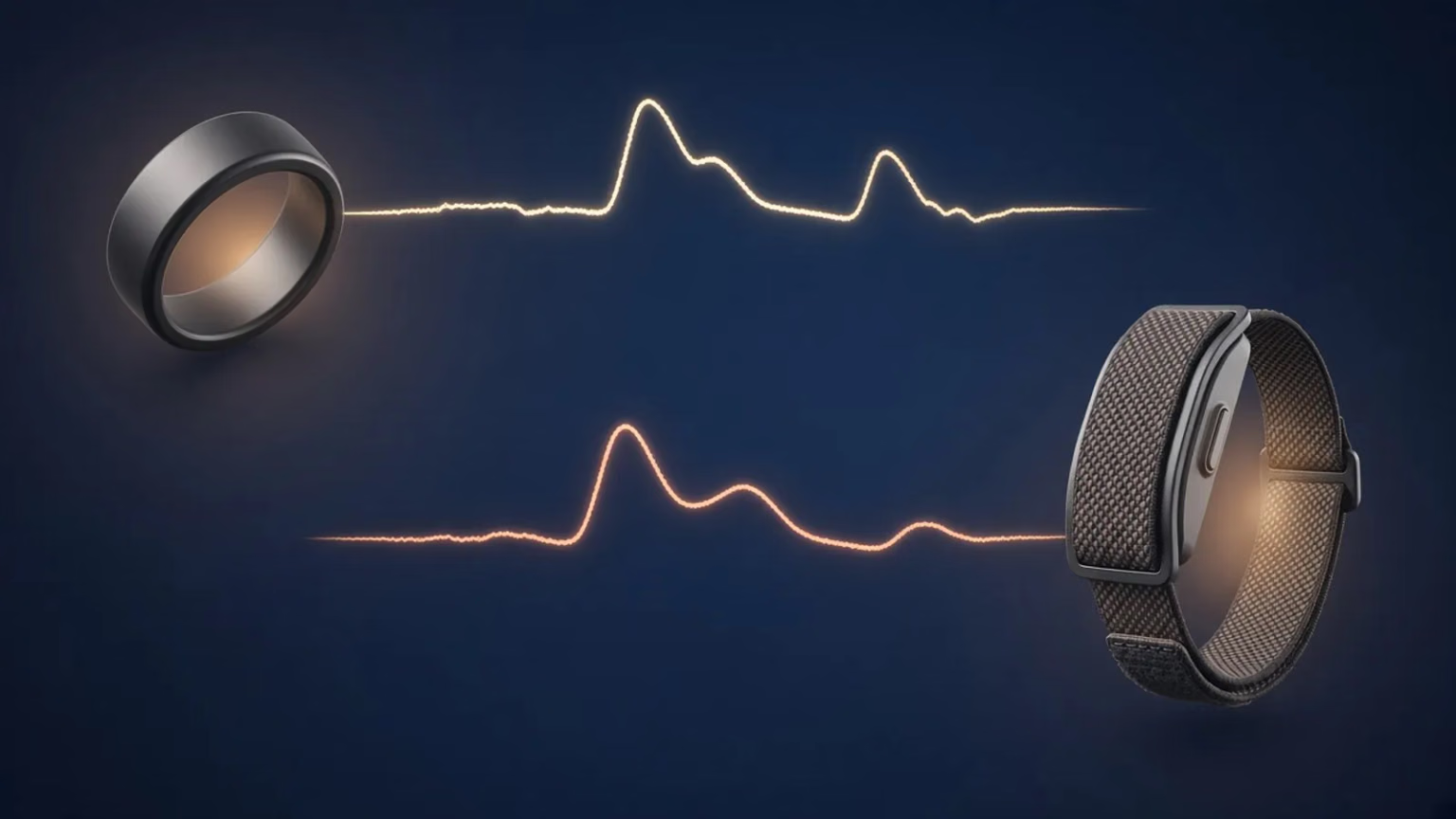
Quick answer: A smart ring and a smartwatch are not better or worse versions of the same sensor. They read the pulse from two different vascular beds, so the photoplethysmography (PPG) waveform itself looks different. Finger PPG tends to be larger, with sharper features and a clearer dicrotic notch. Wrist PPG tends to be smaller and smoother, sitting over a different mix of tissue and vessels, with a form factor that suits a band and longer daytime wear. Pick the site that fits the question, not the one with the louder marketing.
The ring versus watch debate usually gets framed as a ranking. Which one is more accurate? Which one wins? That framing skips the physics. An optical sensor does not measure "heart rate." It measures how much light the tissue under it absorbs and scatters as blood volume changes with each beat 1. Move the sensor to a different part of the body and you change the tissue, the vessels, the perfusion, the pressure, and the motion. The waveform changes with it.
This piece walks through what actually differs between finger and wrist PPG, what the peer-reviewed comparisons found, and which kinds of questions each site suits. If you are new to the signal itself, start with our primer on photoplethysmography.
Same physics, different tissue
Every reflective PPG sensor does the same basic thing. LEDs shine light into the skin, a photodiode measures what comes back, and the pulsatile part of that return (often called the AC component) rides on a much larger steady part (the DC component) from skin, tissue and non-pulsing blood 1. The pulsatile part is the signal. Everything else is context or noise.
What sits under the sensor decides how strong and how shaped that pulsatile part is. Wearable PPG reviews make the point directly: the measurement site, the wavelength, the sensor geometry and how the device sits on the body all shape the signal before any algorithm sees it 2, 13.
So "ring vs watch" is really "finger vs wrist," plus the engineering choices each form factor allows.
The finger: a dense, well perfused vascular bed
The finger is one of the classic PPG sites for a reason. It carries a rich network of small arteries and capillaries, and its pulse is typically strong. In a study that recorded PPG sequentially from six body sites in 36 healthy adults (finger, the underside and top of the wrist, upper arm, earlobe and forehead), the finger produced the largest mean pulse amplitude and the highest share of waveforms clean enough to analyze 3.
A strong pulse matters beyond counting beats. Waveform shape features, such as the time to the systolic peak, the dicrotic notch, and the reflection index, are easier to measure when the pulse stands well above the noise. A large share of the PPG morphology literature, including second-derivative analysis, was built on fingertip recordings for exactly this reason 12. Research on vascular ageing also leans heavily on these shape features 11.
One honest caveat. Most finger PPG research records at the fingertip, often with a clip. A smart ring sits at the base of the finger, around the proximal phalanx, where the tissue and vessel layout differ. Fingertip findings point in a direction. They do not transfer one-to-one to a ring.
The wrist: smaller pulse, smoother shape
The wrist is where most wearables live, and its pulse looks different. In the same six-site comparison, wrist PPG had smaller amplitude than the finger and different timing features: the time to peak and the reflection index both differed significantly from the finger 3. A separate study of 30 adults compared wrist and finger PPG side by side and reported that the two signals differed in both shape and amplitude 4.
In practice, wrist waveforms often look rounder. The dicrotic notch, which is crisp on many finger recordings, frequently softens into a shoulder on the wrist. That does not make the wrist a worse site. It makes it a different one. Rajala and colleagues found that features such as the pulse foot and the first-derivative peak were still usable for timing analysis from the wrist 4. The analysis just has to be designed for the waveform you actually have, not the textbook fingertip curve.
The wrist also allows a bigger sensor footprint than a ring. A band can carry several LEDs and photodiodes and multiple wavelengths, spread over a wider window of skin. That is a design freedom, not a guarantee of quality, but it is one of the real tradeoffs between the two form factors 2.
Morphology side by side
Here is how the two sites tend to differ, based on the comparisons above and the wearable PPG literature.
| Feature | Finger (ring) | Wrist (band or watch) |
|---|---|---|
| Vascular bed | Dense, well perfused small arteries and capillaries | Mixed tissue, tendons and bone close to the surface |
| Pulse amplitude | Typically larger 3 | Typically smaller 3 |
| Dicrotic notch | Often clearly visible | Often softened into a shoulder |
| Timing features | Shorter time to peak, lower reflection index 3 | Different peak timing and reflection index 3, 4 |
| Sensor footprint | Small, curved inner surface | Larger window, room for more emitters and wavelengths |
| Typical wear | Comfortable overnight, small and low profile | Day and night, easy to put on and check fit |
None of these rows names a winner. A larger pulse helps waveform analysis. A larger sensor window helps optical design. Comfort helps people keep the device on, and data you never collect has no quality at all.
Motion: no site is immune
Motion is the main enemy of optical pulse signals at every site. When the body moves, blood volume under the sensor shifts for reasons that have nothing to do with the heartbeat, and the sensor can slide relative to the skin 6, 9.
The site comparisons are humbling. Longmore and colleagues tested eight anatomical locations at rest and while walking. The finger was the best overall site at rest for heart rate, oxygen saturation and respiration rate together, but no site could measure all three well while walking 5. Maeda and colleagues found that measurement site and wavelength both changed how much motion artifact appeared, with green light tracking heart rate better than infrared during movement and the upper arm showing less artifact than more peripheral sites 6.
For wrist devices specifically, Bent and colleagues compared consumer and research wearables across activities and found absolute error during activity was on average about 30% higher than at rest, with clear differences between devices 8.
The practical takeaway: both rings and wrist bands do their best work in still windows. Sleep and rest are where most continuous PPG metrics, especially interval-based ones like HRV, are captured with confidence. For more on how teams handle this, see PPG signal quality and our piece on PPG beat detection.

For research and product teams
Put the raw signal in your study or product
If your protocol depends on waveform shape and not only heart rate, we can look at capture settings and wear windows with you before first enrollment.
Contact pressure and ambient light
Contact matters at both sites, in different ways. Teng and Zhang measured finger PPG while gradually increasing sensor contact force. Pulse amplitude and the ratio of pulsatile to steady signal rose at first, then fell, and the force that gave the best pulse varied from person to person 7. Too loose and light leaks in and the sensor shifts. Too tight and the vessels under the sensor are compressed.
A ring has a fixed inner diameter, so its pressure depends on sizing and on how fingers swell through the day and night. A band can be tightened or loosened, which helps fit but also means pressure changes whenever someone adjusts it. Neither is automatically better. Both need fit guidance and a quality signal that flags poor contact.
Ambient light is the other quiet variable. Reflective PPG sensors pick up any outside light that reaches the photodiode, and sensor design choices such as shielding, LED and photodiode spacing, and how the housing seals against skin all affect it 13. A ring's curved surface and a band's flat window solve that problem differently.
Skin and tissue also shape what each wavelength can see, which is one reason multi-wavelength capture is useful for research 9. Our review of PPG and skin tone covers that evidence.
What rings do well
The ring literature is strongest for overnight, resting measures. In a home study of 35 healthy adults, nightly heart rate and HRV from a commercial smart ring showed low mean bias against a chest ECG reference, with more spread in some frequency-domain HRV parameters in short five-minute windows 10.
That fits the form factor. A ring is small, people tend to wear it to bed, and the finger's strong pulse helps during still periods. Rings are a reasonable fit for:
- Overnight heart rate and HRV trends
- Sleep-window studies where comfort drives adherence
- Programs where people will not wear anything on the wrist
What wrist wearables do well
Wrist wearables fit the way people already wear things during the day. A band is easy to put on, easy to check for fit, and has room for more sensors and battery. Wrist PPG is a natural fit for:
- Day and night wear in the same device
- Programs that pair PPG with accelerometer context for activity and rest
- Research that needs multi-wavelength raw waveforms and a defined sample rate
- Timing features from the pulse foot or first-derivative peak, designed for wrist morphology 4
Choosing by question, not by ranking
A simple way to choose: start from the measurement, then the wear pattern, then the form factor.
- What do you need from the waveform? If the analysis depends on fine shape features like a crisp dicrotic notch, a strong finger pulse helps. If it needs beat timing, rate and trends, both sites can work with the right processing.
- When will people wear it? Overnight-only programs suit rings well. Programs that need day and night data in one device suit a band.
- How much motion? Plan quality checks and still windows either way. No site solves motion 5, 8.
- Do you need the raw signal? If your team wants to audit quality, re-derive features or train models, raw multi-wavelength access matters more than the body site.
- Will people keep wearing it? The best signal is the one you actually collect for the whole study.
For a broader checklist, see how to choose a wearable for research. For a vendor-neutral technical comparison of the two sensor sites, see this ring vs wrist PPG sensor comparison.
Where Sensor Bio V2 fits
Sensor Bio V2 is a health and wellness wearable worn on the wrist, so it lives with wrist morphology, not finger morphology. It is built for teams that want the waveform itself: raw green, red and infrared PPG at 25, 50 or 100 Hz, available to partners through the SDK and a per-organization download. Details are in raw PPG access for partners.
That choice is a tradeoff like any other. It gives research and product teams day and night wear, multi-wavelength access and room to design their own quality rules. It does not turn the wrist into a fingertip. Sensor Bio V2 is not FDA cleared, and its biometrics are for general health and wellness.
- Allen J. Photoplethysmography and its application in clinical physiological measurement. Physiol Meas. 2007;28(3):R1-R39. Source
- Charlton PH, Kyriacou PA, Mant J, Marozas V, Chowienczyk P, Alastruey J. Wearable photoplethysmography for cardiovascular monitoring. Proc IEEE. 2022;110(3):355-381. Source
- Hartmann V, Liu H, Chen F, Qiu Q, Hughes S, Zheng D. Quantitative comparison of photoplethysmographic waveform characteristics: effect of measurement site. Front Physiol. 2019;10:198. Source
- Rajala S, Lindholm H, Taipalus T. Comparison of photoplethysmogram measured from wrist and finger and the effect of measurement location on pulse arrival time. Physiol Meas. 2018;39(7):075010. Source
- Longmore SK, Lui GY, Naik G, Breen PP, Jalaludin B, Gargiulo GD. A comparison of reflective photoplethysmography for detection of heart rate, blood oxygen saturation, and respiration rate at various anatomical locations. Sensors. 2019;19(8):1874. Source
- Maeda Y, Sekine M, Tamura T. Relationship between measurement site and motion artifacts in wearable reflected photoplethysmography. J Med Syst. 2011;35(5):969-976. Source
- Teng XF, Zhang YT. The effect of contacting force on photoplethysmographic signals. Physiol Meas. 2004;25(5):1323-1335. Source
- Bent B, Goldstein BA, Kibbe WA, Dunn JP. Investigating sources of inaccuracy in wearable optical heart rate sensors. NPJ Digit Med. 2020;3:18. Source
- Fine J, Branan KL, Rodriguez AJ, et al. Sources of inaccuracy in photoplethysmography for continuous cardiovascular monitoring. Biosensors. 2021;11(4):126. Source
- Cao R, Azimi I, Sarhaddi F, et al. Accuracy assessment of Oura ring nocturnal heart rate and heart rate variability in comparison with electrocardiography in time and frequency domains: comprehensive analysis. J Med Internet Res. 2022;24(1):e27487. Source
- Charlton PH, Paliakaitė B, Pilt K, et al. Assessing hemodynamics from the photoplethysmogram to gain insights into vascular age: a review from VascAgeNet. Am J Physiol Heart Circ Physiol. 2022;322(4):H493-H522. Source
- Elgendi M. On the analysis of fingertip photoplethysmogram signals. Curr Cardiol Rev. 2012;8(1):14-25. Source
- Tamura T, Maeda Y, Sekine M, Yoshida M. Wearable photoplethysmographic sensors: past and present. Electronics. 2014;3(2):282-302. Source
Related reading

Real-time physiological data streaming: platform needs
Review the latency, timing, signal-quality, interoperability, and security requirements for streaming physiological data into digital health systems.
Read
PPG Signal Quality: The Physiology Behind Wearable Accuracy
Why PPG waveform quality determines wearable metric validity: a validation checklist, common failure modes (motion, perfusion, skin tone), and product rules for abstention and reporting.
Read
How wearables measure stress: what PPG research shows
An evidence review of stress detection with wearable PPG. Which signals change under stress, what lab and real-world studies found, why most results stay in the lab, and how to design a stress study around raw pulse data.
Read
Wearable sleep apnea research: what PPG studies show about breathing in sleep
An evidence review of wearable PPG for breathing rate and sleep-disordered breathing. How light-based signals pick up breathing, what apnea screening studies and the first regulated wrist feature found, and why sleep studies remain the reference.
Read
Can a watch measure glucose? What wearable PPG research actually shows
A research review of PPG, glucose and diabetes. No smartwatch or ring is authorized to measure blood glucose on its own. Here is what light-based studies have tried, what they found about diabetes-related vascular change, and where the limits are.
Read
Wearable blood pressure research: what PPG shows about trends and vascular aging
An evidence review of cuffless blood pressure research with wearable PPG. What pulse timing and pulse shape studies found, why calibration and validation decide the results, what night-time trends add, and how PPG is used to study vascular aging.
Read